
What Does Spirituality Mean? A Comparative Perspective Across Religious and Non-Religious Traditions
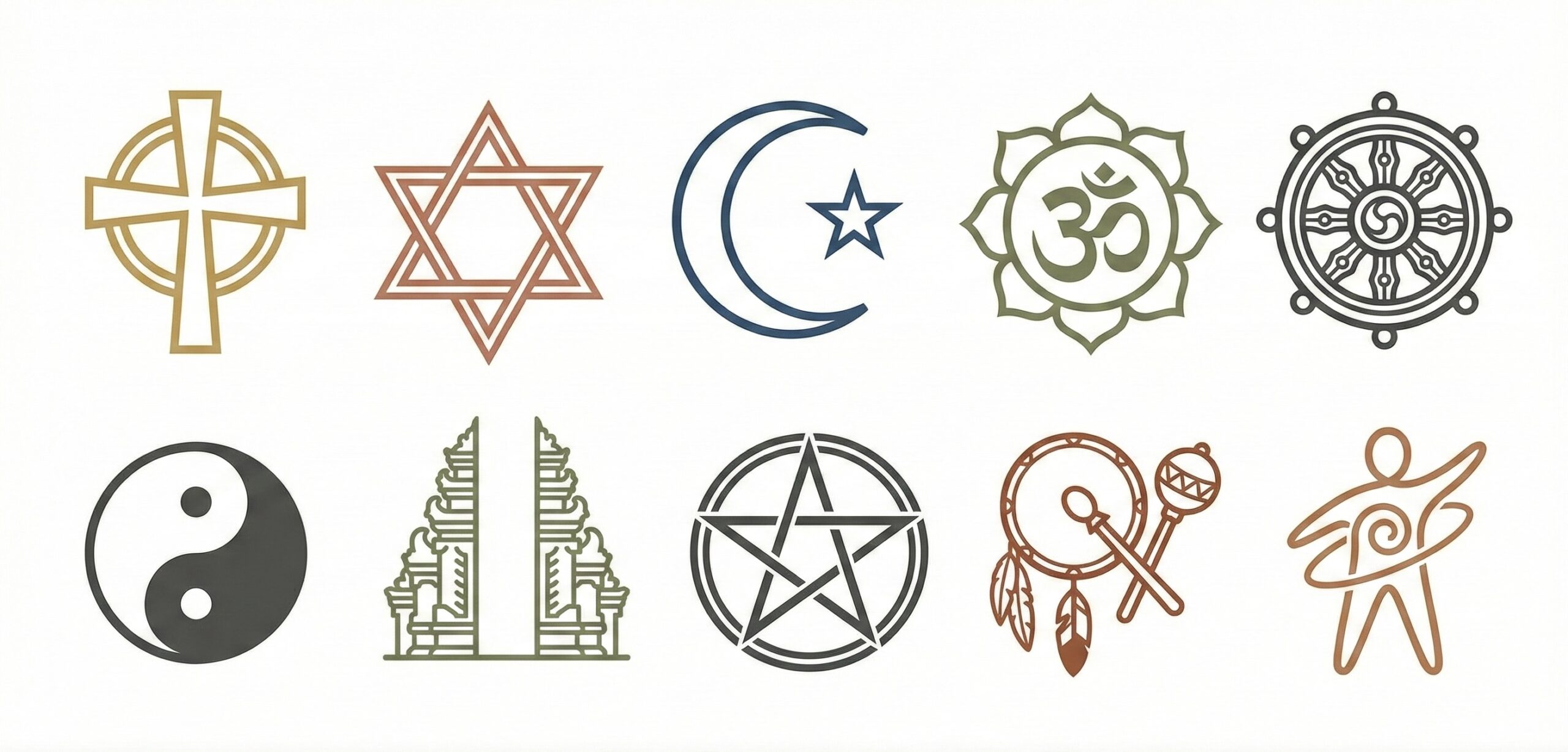
The word spirituality is widely used today, yet its meaning varies significantly depending on cultural, religious, philosophical, and historical contexts. For some, spirituality refers to a relationship with God; for others, it points to inner transformation, ethical life, or a sense of connection with the universe. This article offers a comparative and introductory exploration of what spirituality means across major religious traditions and non-religious frameworks, providing a conceptual map for deeper, tradition-specific studies.
The aim of this introduction is not to synthesize or harmonize these perspectives, but to present each on its own terms, based on authoritative sources and scholarly analysis. The traditions examined here include Catholic Christianity, Judaism, Islam, Hinduism, Buddhism, Taoism, Balinese spirituality, esoteric spirituality, shamanic spirituality, and non-religious spirituality.
What Do We Mean by “Spirituality”?
Historically, the concept of spirituality emerged within religious contexts. In Christian theology, the Latin term spiritualitas referred to life “according to the Spirit” (spiritus), in contrast to life according to the flesh (caro) (New Testament, Romans 8:1–14). Over time, the term expanded beyond strictly theological usage.
In contemporary academic discourse, spirituality is commonly defined as a search for meaning, purpose, and transformation that may or may not take place within institutional religion. Sociologist Danièle Hervieu-Léger defines spirituality as a “subjective appropriation of meaning” that may detach itself from traditional religious authority (Hervieu-Léger, Le pèlerin et le converti, 1999).
Thus, spirituality today functions as an umbrella term encompassing religious, philosophical, experiential, and ethical dimensions. To understand it properly, one must examine how each tradition defines the human condition, ultimate reality, and the path toward fulfillment or liberation.
Spirituality in Catholic Christianity
In Catholic Christianity, spirituality is fundamentally relational. It refers to the lived relationship between the human person and God, mediated through Jesus Christ and animated by the Holy Spirit. According to the Catechism of the Catholic Church, spiritual life is participation in the life of God through grace (CCC §1997).
The Bible presents spirituality as life “in the Spirit” (Galatians 5:16–25), characterized by faith, hope, and charity. Spiritual growth involves prayer, sacraments, moral life, and participation in the Church. The ultimate goal is union with God, often described as sanctification or holiness.
Classical theologians such as Augustine of Hippo and Thomas Aquinas emphasize interior transformation guided by divine grace. Catholic spirituality is inseparable from doctrine and communal worship, yet it also includes rich contemplative traditions (e.g., Benedictine, Carmelite).
Spirituality in Judaism
In Judaism, spirituality is not primarily defined as an inner state but as faithful living within the covenant (berit) between God and Israel. The Torah serves as both law and spiritual guide, shaping daily life through commandments (mitzvot).
Rather than withdrawal from the world, Jewish spirituality emphasizes the sanctification of ordinary life. As expressed in Deuteronomy 6:5, love of God is enacted through obedience and ethical conduct. Spirituality is therefore communal, embodied, and historical.
Mystical currents such as Kabbalah introduce deeper contemplative dimensions, focusing on divine emanations (sefirot) and spiritual repair (tikkun olam), but these remain anchored in Torah observance (Scholem, Major Trends in Jewish Mysticism, 1941).
Spirituality in Islam
Islamic spirituality centers on conscious submission to God (Allah) and constant awareness of His presence. The Qur’an describes true success as purification of the soul (Qur’an 91:7–10).
Key spiritual concepts include taqwā (God-consciousness), niyyah (intention), and ihsān (excellence in worship, defined in a famous hadith as worshiping God “as if you see Him”).
While Islamic spirituality is grounded in law (sharī‘a), it also includes inner dimensions cultivated through prayer, fasting, charity, and remembrance of God (dhikr). Sufism represents the mystical articulation of Islamic spirituality but remains rooted in Qur’an and Sunnah.
Spirituality in Hinduism
Hindu spirituality encompasses a wide range of philosophical and devotional paths unified by the pursuit of liberation (moksha) from the cycle of rebirth (samsāra). Central texts such as the Upanishads explore the identity between the individual self (ātman) and ultimate reality (Brahman).
Unlike monotheistic traditions, Hinduism offers multiple spiritual paths (yogas): knowledge (jnāna), devotion (bhakti), action (karma), and meditation (rāja). Spirituality is thus pluralistic and adaptive.
Ethical duty (dharma) and spiritual realization are intertwined, with practices varying according to life stage and social context (Radhakrishnan, Indian Philosophy, 1951).
Spirituality in Buddhism
Buddhist spirituality is oriented toward awakening (bodhi) and the cessation of suffering (dukkha). The Buddha’s teaching centers on the Four Noble Truths and the Eightfold Path.
Unlike theistic traditions, Buddhism does not posit a creator God. Spiritual practice aims at realizing impermanence (anicca), non-self (anattā), and unsatisfactoriness (dukkha).
Meditation, ethical conduct, and wisdom form an integrated path leading to nirvana. Spirituality here is experiential and pragmatic, verified through practice rather than belief (Rahula, What the Buddha Taught, 1959).
Spirituality in Taoism
Taoist spirituality emphasizes harmony with the Tao, the ineffable principle underlying all reality. The Tao Te Ching, attributed to Laozi, describes spirituality as alignment with natural processes rather than moral effort.
Key concepts include wu wei (non-forcing), simplicity, and spontaneity. Spiritual realization involves letting go of artificial distinctions and returning to natural balance.
Taoist spirituality is non-dual and immanent, focusing on balance, longevity, and inner cultivation rather than salvation or transcendence (Ames & Hall, Dao De Jing, 2003).
Spirituality in Balinese Culture
Balinese spirituality, a localized form of Hinduism, integrates ritual, cosmology, and communal life. Its core principle, Tri Hita Karana, emphasizes harmony between humans, nature, and the divine.
Spirituality is expressed through daily offerings, temple festivals, and ancestral rituals. Rather than individual liberation, the focus lies on maintaining cosmic balance.
This spirituality is inseparable from cultural identity and social structure (Geertz, The Interpretation of Cultures, 1973).
Spirituality in Esoterism
Esoteric spirituality refers to traditions that emphasize hidden knowledge accessible through initiation and symbolic interpretation. According to Antoine Faivre, its defining features include correspondences, living nature, imagination, and inner transformation (Access to Western Esotericism, 1994).
Esoteric currents exist within Judaism (Kabbalah), Christianity, Islam, and independent traditions such as Hermeticism. Spirituality here is initiatory and transformative rather than institutional.
Spirituality in Shamanism
Shamanic spirituality involves mediation between visible and invisible realms, typically through altered states of consciousness. Anthropological studies describe it as a traditional religious function rather than a universal doctrine (Eliade, Shamanism, 1951).
In modern contexts, neo-shamanic practices often blend indigenous techniques with contemporary spiritual individualism, raising important distinctions between traditional and modern forms (Hutton, Shamans, 2001).
Non-Religious Spirituality
Non-religious spirituality refers to the pursuit of meaning, depth, and transformation without adherence to a religious institution or revealed doctrine. It emphasizes personal experience, ethical coherence, and existential reflection.
Philosophers and sociologists describe it as characteristic of modern secular societies, where individuals construct spiritual meaning independently (Taylor, A Secular Age, 2007).
Conclusion: A Plural Concept
Spirituality is not a single, unified concept but a family of meanings shaped by theology, philosophy, culture, and experience. Understanding its diversity is essential for meaningful dialogue and deeper study. The following articles in this series will explore each tradition in greater depth, using the same analytical framework to facilitate comparison.
